

How did RF communication become the decisive factor in modern warfare?
I watch pilots, missiles, and radars move like chess pieces. Yet the quiet RF link decides who sees first, who strikes first, and who survives.
Yes. Modern warfare favors RF dominance. Stealth coatings, jammers[^1], data links, and precision guidance ride on RF chains. Control the spectrum, blind the enemy, protect your links, and you win.
I will not sell drama. I will unpack real RF logic from recent US–Israel–Iran confrontations, then map it to design choices I make every day as an RF engineer in phased array radar[^2] and power amplifiers.
How did RF communication evolve from a side tool to the core of war?
We often think armor wins wars. But every decade, RF solved a harder problem: distance, speed, interference, and integration. With each step, it took command.
RF advanced in five steps: spark-to-Morse, voice and FM, integrated radar-networks, digital SDR[^3], then 5G-to-6G and space networks[^4]. Each step improved range, reliability, and anti-jam performance.
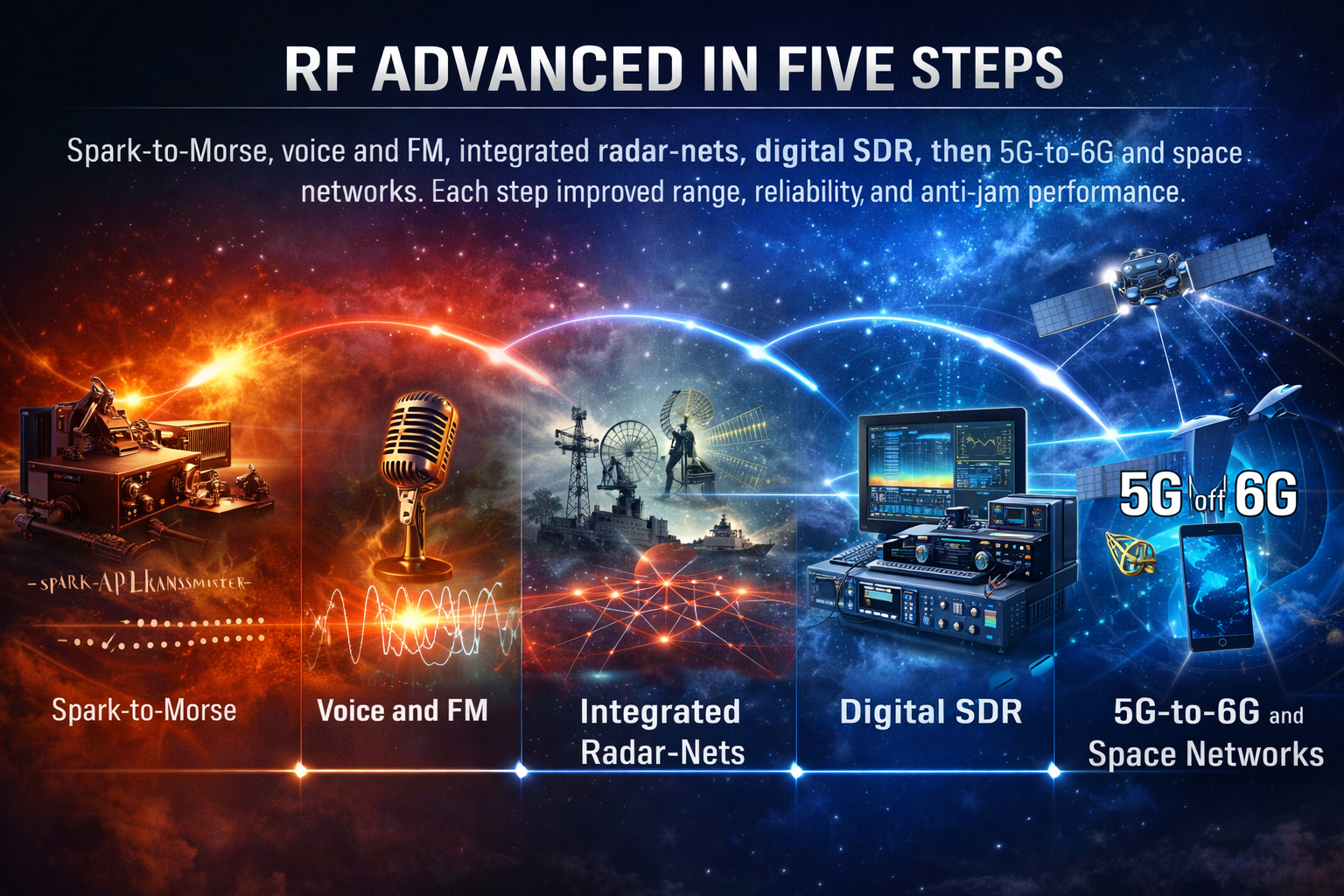
I break the century into five clean phases and tie each phase to battlefield impact and engineer choices.
Phase 1: Birth (1890s–1918)
- Core move: wireless telegraphy, long-range HF hops.
- Battlefield effect: messages without wires, fragile and easy to jam.
- Design lesson: antennas and basic link budgets matter most.
Phase 2: Growth (1918–1945)
- Core move: AM to FM voice, first encryption, first operational radar.
- Battlefield effect: faster command, better air and naval control.
- Design lesson: modulation choice trades SNR against robustness; front-end linearity begins to matter.
Phase 3: Systemization (1945–1980s)
- Core move: transistors, SATCOM[^5], frequency hopping[^6], ECM/ECCM.
- Battlefield effect: multi-domain command nets, electronic warfare as doctrine.
- Design lesson: power efficiency and thermal design in PAs, frequency agility in synthesizers.
Phase 4: Digital/Intelligent (1980s–2000s)
- Core move: SDR[^3], error control coding, adaptive links, GPS integration.
- Battlefield effect: precision strike, network-centric operations.
- Design lesson: waveform agility, ADC/DAC performance, isolation inside dense RFSoCs.
Phase 5: Connected/6G-bound (2000s–now)
- Core move: 5G/LEO constellations, THz R&D, AI-driven spectrum use.
- Battlefield effect: resilient, low-latency, global meshes; unmanned teaming.
- Design lesson: beamforming at scale[^7], distributed MIMO[^8], cross-layer anti-jam.
| Phase | Tech lever | War advantage | Engineer levers |
|---|---|---|---|
| 1 | HF telegraphy | Beyond-line-of-sight comms | Antenna gain, link budget |
| 2 | FM, radar | Clear voice, early warning | Modulation, linearity |
| 3 | Hop/SATCOM[^5] | Survive jamming, reach globally | Synthesizers, PA thermal |
| 4 | SDR+GPS | Precision & agility | Waveform, converters |
| 5 | 5G/LEO/AI | Resilient mesh | Beamforming, MIMO |
Why does RF decide “see, decide, strike” today?
I see three pillars at work: sensing, command, and precision strike. Each lives or dies on RF links and RF deception.
RF is the eyes, nerves, and hands of modern forces. Blind the enemy’s sensors, cut their links, and spoof their guidance, and their weapons become loud but dumb metal.
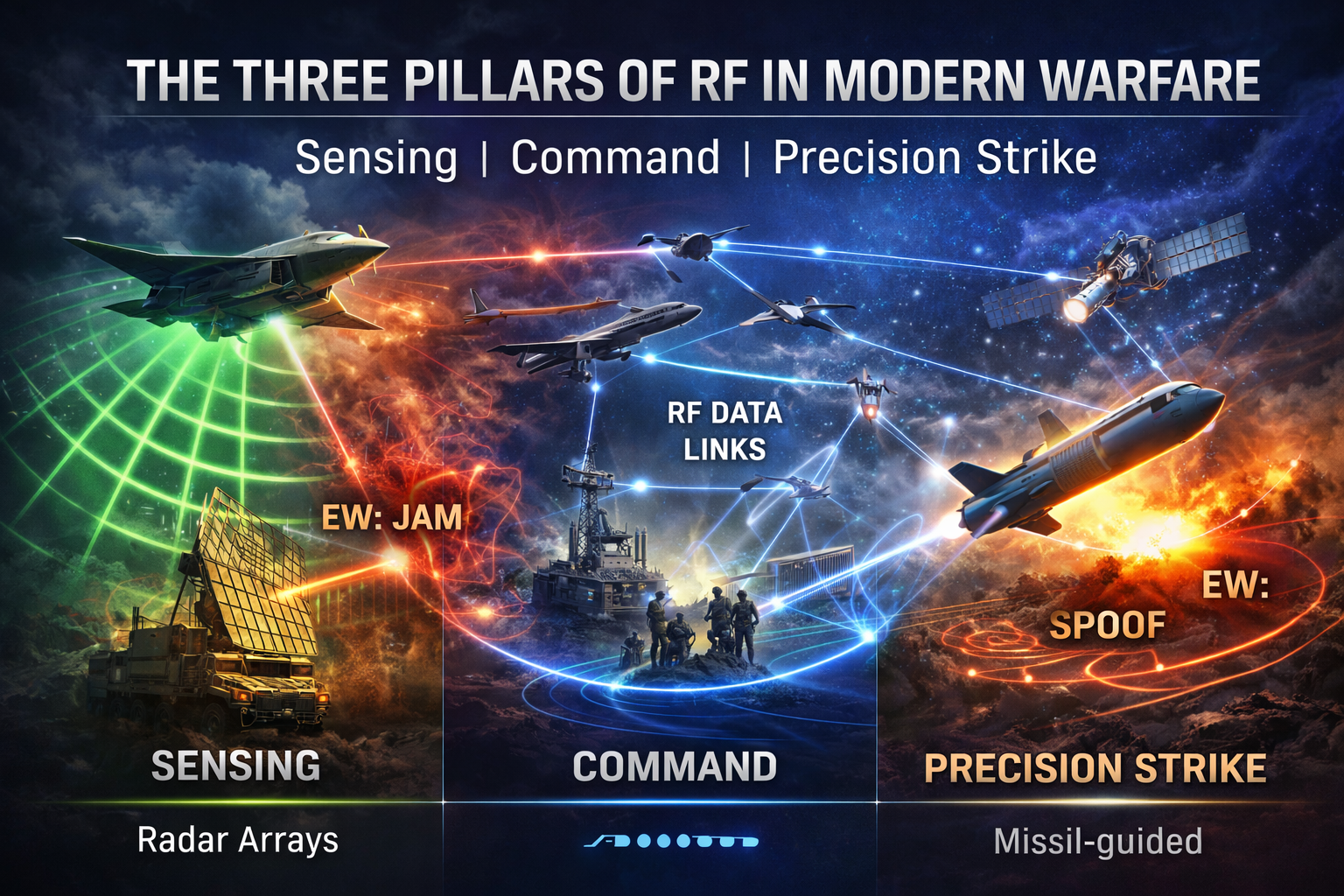
I map each pillar to concrete mechanisms and design knobs I use.
1) Sensing (radar/ESM/space RF)
- Mechanisms: wideband radar, multistatic networks[^9], passive RF sensing[^10], L- to VHF-band for counter-stealth.
- Anti-stealth: long-wavelength radars exploit resonance and RCS spikes; multistatic geometry defeats shaping.
- Engineer knobs: low-noise figure LNAs[^11], high-DR AD converters, clutter rejection, MIMO radar with waveform diversity[^12].
- Example lens: counter-stealth radars like VHF/UHF arrays push PA efficiency at low bands and require precise calibration across large apertures.
2) Command and control (C2)
- Mechanisms: frequency hopping[^6], beamformed air relays, SATCOM[^5] backup, cross-layer ARQ/FEC.
- Anti-jam: directive beams, time/frequency diversity, fast hop re-sync, autonomous routing.
- Engineer knobs: phase noise in PLLs (hop settling)[^13], EVM under PA compression, duplexer isolation, crypto latency budget.
3) Precision strike (RF seekers/GNSS/INS)
- Mechanisms: home-on-jam seekers, RF scene matching[^14], multi-constellation GNSS, two-way datalinks for mid-course updates.
- Anti-jam: multi-band GNSS (e.g., tri-frequency), null-steering antennas[^15], adaptive notch filters, IMU blending.
- Engineer knobs: antenna array patterns, fast AGC loops, linearized PAs for datalink integrity, shielding to curb self-jam.
| Pillar | Threat | RF defense | Key components |
|---|---|---|---|
| Sensing | Stealth, clutter | Long-wave, MIMO, coherent processing | LNA, ADC, clocks |
| C2 | Barrage/DRFM jamming | FHSS, beamforming, FEC | PLL/VCO, PA, filters |
| Strike | GNSS spoof/jam | Tri-band GNSS, nulling, HOJ | Antenna arrays, DSP |
How do stealth and jamming really interact in the field?
Stealth lowers detection probability. Jamming raises noise and confusion. They meet in the radar equation and in timing, not just slogans.
Stealth cuts RCS. Radar counters with lower frequencies, multistatic setups, and better processing. Jamming raises J/S. Radar fights back with ECCM: agility, polarization, sidelobe control, and passive cues.
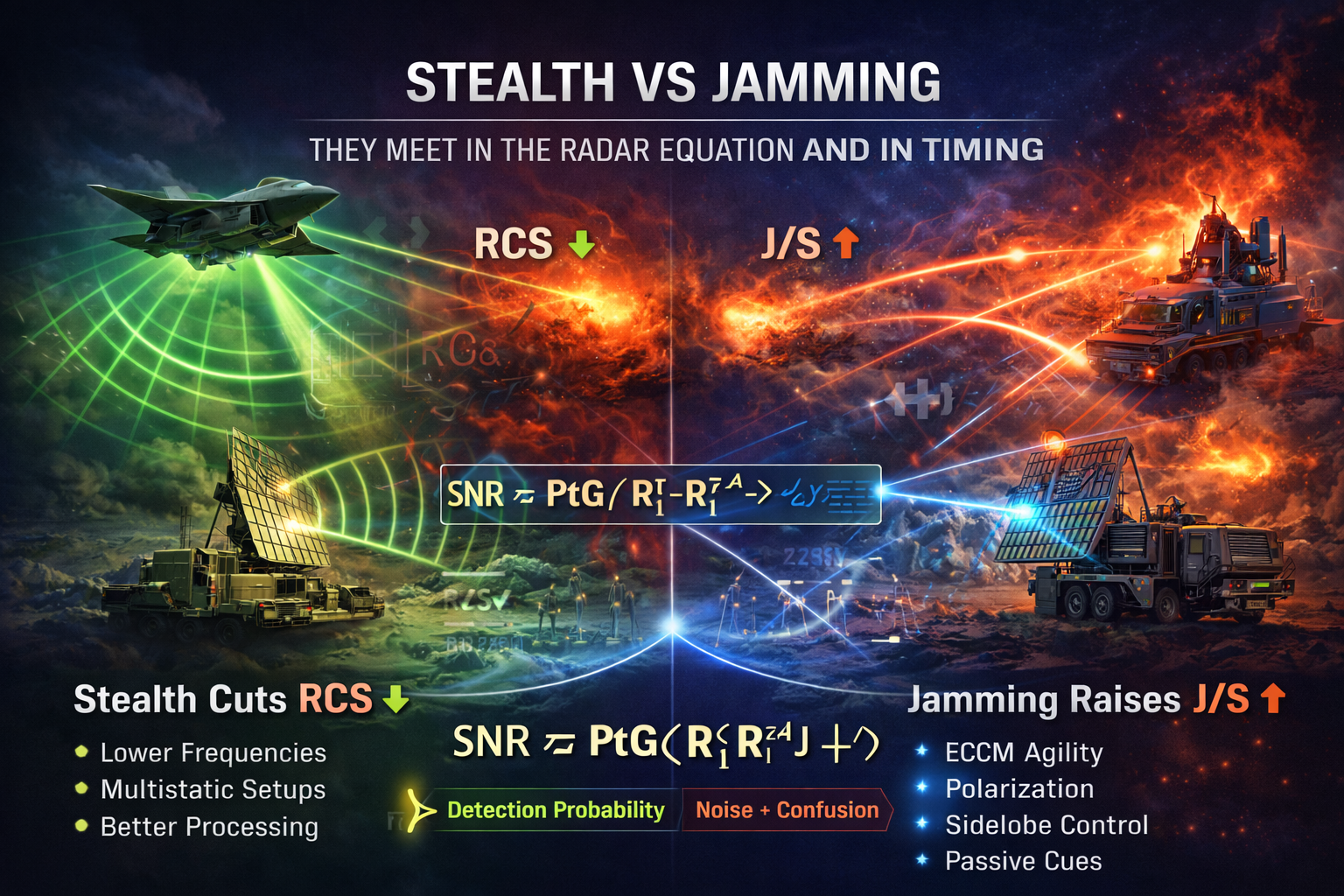
I see five practical battlegrounds.
A) Frequency
- Stealth shaping peaks at X/Ku,. VHF/UHF reduces shaping benefits.
- Design task: wide-tuning front ends, switchable antennas, and PA matching across bands.
B) Geometry
- Multistatic or passive radar views stealth from unplanned angles.
- Design task: precise timing/sync; clock distribution with sub-ns jitter.
C) Agility
- Radars hop frequency, PRF, and waveform to punish DRFM repeaters.
- Design task: fast, phase-coherent hops; DAC/FPGA waveforms with low spurs.
D) Sidelobes
- Jammers hunt sidelobes; arrays must suppress them.
- Design task: amplitude/phase calibrations, DPD for array PAs, thermal stabilization.
E) Power and protection
- Jammers drive huge ERP; receivers must not burn.
- Design task: limiter design, T/R switch recovery time, intermod management under high fields.
| Contest field | Jammer move | Radar counter | Required specs |
|---|---|---|---|
| Frequency | Noise/spot | Agile, multi-band | <1 µs hop |
| Geometry | Off-axis | Multistatic | <100 ps sync |
| Sidelobes | Lobe-staring | Low sidelobe tapers | <-40 dB SLL |
| Power | Blinding | Limiters, recovery | <1 µs recovery |
What design choices matter most for resilient RF links?
In my builds, four levers decide survival: link budget, agility, beam control, and clean clocks. Miss one, and the rest fail.
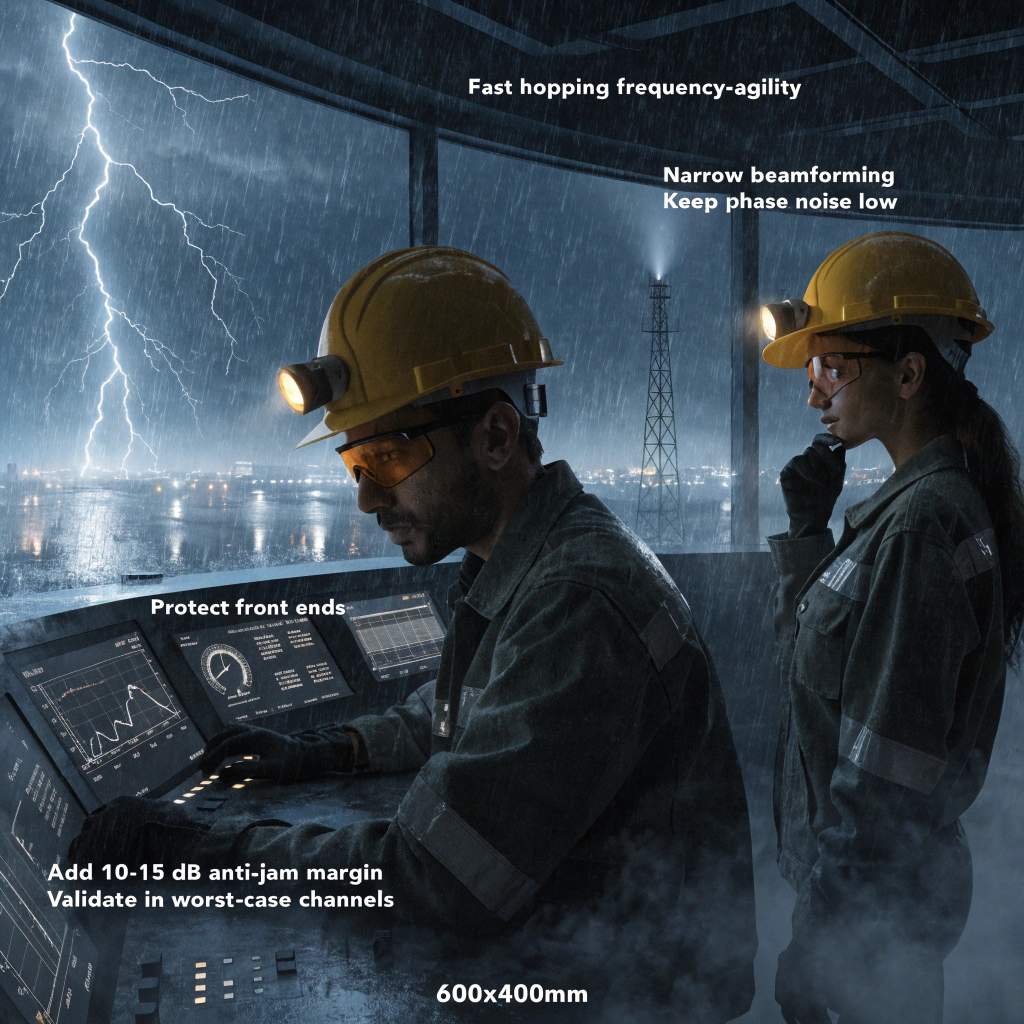
Engineer for margin and adaptability. Add 10–15 dB anti-jam margin, make hops fast, keep beams narrow, and keep phase noise low. Protect front ends. Validate in worst-case channels.
I translate battlefield needs into block-level choices.
Link budget and margin
- Start with conservative fades and interference. I budget extra 12 dB for jamming.
- Use coding gain: LDPC/Turbo adds 4–8 dB at practical throughput.
- PA linearity trades against efficiency; I keep 3–5 dB backoff on critical data links.
Agility and redundancy
- Frequency hopping at >1000 hops/s with dwell <1 ms reduces jammer coupling.
- Multi-band radios (L/S/C) give route choices when one band is hot.
- Dual crypto paths protect against key compromise without halting links.
Beam and array hygiene
- Narrow beams raise processing gain by 10–20 dB.
- I run array calibration every thermal step (e.g., 5°C) to hold sidelobes down.
- Null-steering against known jammer bearings buys 20–40 dB more resilience.
Clock and synchronization
- Phase noise affects EVM and radar range-Doppler sidelobes.
- I spec < -100 dBc/Hz at 10 kHz offset on X-band synths for clean hops and LPI.
- Time distribution over fiber with PTP/White Rabbit keeps sub-ns alignment.
| Lever | Typical target | Why it matters |
|---|---|---|
| Anti-jam margin | ≥12 dB | Survive noise/spot barrage |
| Hop rate | >1 kHz | Outpace reactive jammers[^1] |
| Beam gain | +15 dB | SNR without more power |
| Phase noise | -100 dBc/Hz @10 kHz | EVM, radar sidelobes |
How does all this change power amplifier choices on phased arrays?
I build arrays for radars and data links. PAs look simple blocks. They decide range, jam power, thermal limits, and spectral purity.
In modern radar and electronic warfare systems, high-power RF amplifiers are essential components.
They provide the transmit power required for long-range radar detection, high-energy jamming, and reliable military communication links.
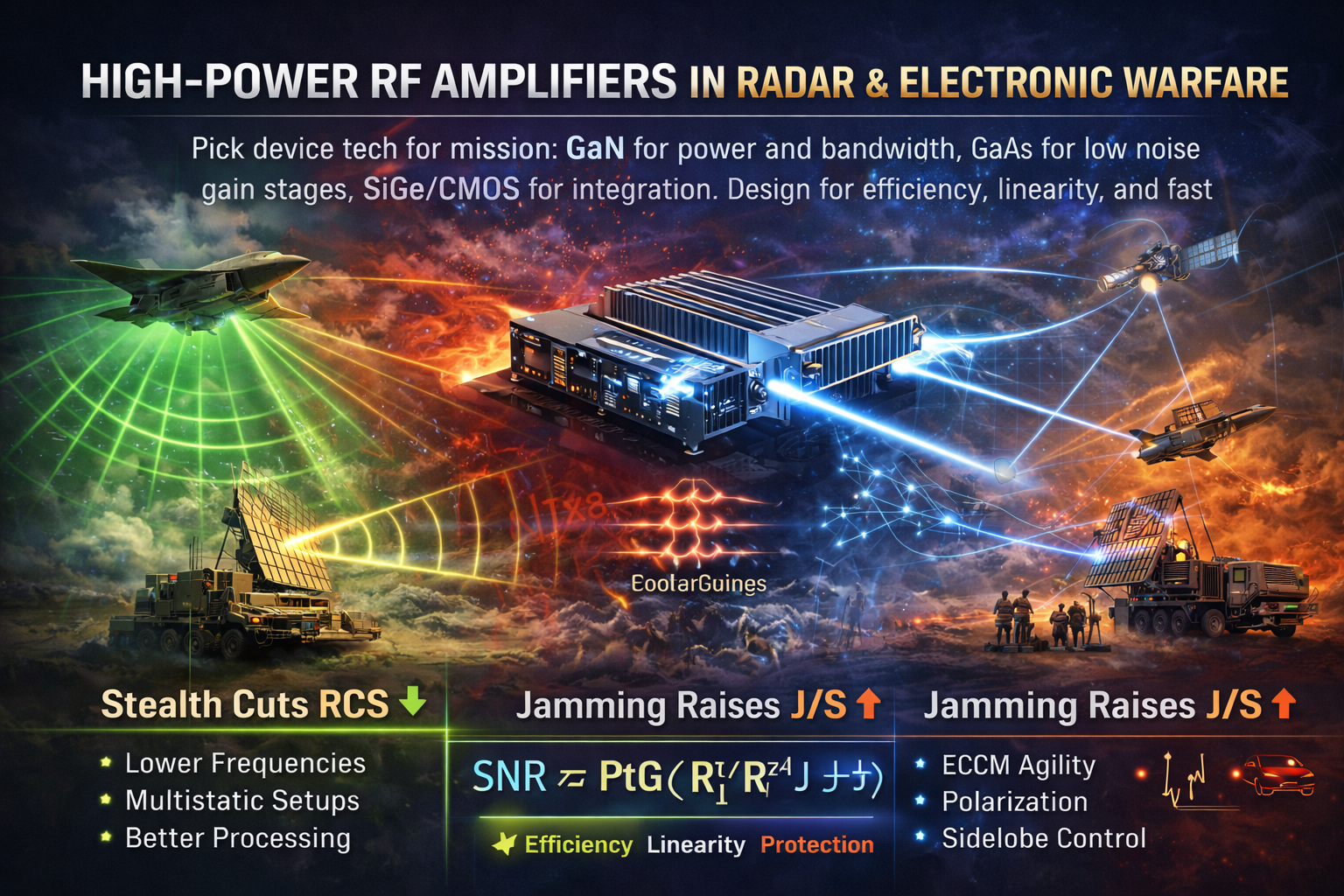
Pick device tech for mission: GaN for power and bandwidth, GaAs for low noise gain stages, SiGe/CMOS for integration. Design for efficiency, linearity, and fast protection.
I treat the PA as both a weapon and a liability.
Device and topology
- GaN HEMTs[^16] give high voltage swing and wideband power for L–X bands.
- Doherty and outphasing architectures trade efficiency vs linearity; I pick Doherty for comms, saturated for radar.
- Backoff strategy: radar can saturate; comms keep 3–6 dB backoff with DPD.
Thermal and lifetime
- Junction temperature sets MTTF; I design for Tj < 160°C under desert ambient.
- Vapor chamber + graphite spreaders keep gradients small across tiles.
- I monitor drain current to detect oscillations early.
Spectral cleanliness
- Jammers need ERP, but arrays must not self-jam neighbors.
- I enforce ACLR/ACPR limits with DPD and good bias networks; filters must tolerate high peak power.
Fast protection and recovery
- T/R switches and limiters must recover in <1 µs after high-power pulses.
- VSWR events on airborne platforms happen; I add foldback within 100 ns.
| PA focus | Radar mode | Comms/EW mode |
|---|---|---|
| Efficiency | Saturated, pulsed | Doherty/backoff |
| Linearity | Moderate | High with DPD |
| Recovery | Fast post-pulse | Fast during hops |
| Cooling | Aggressive | Aggressive |
Conclusion
Modern war is a spectrum fight. If I protect my links, blind theirs, and keep precision under jamming, planes and missiles follow. RF wins first, then everything else.
Acura specializing in wide range of high-power RF amplifiers forplay an important role in supporting radar development, electronic warfare systems, and satellite communication testing. More details, pls. review our webiste https://acuramw.com/pulsed-power-amplifier, welcome to contact us by [email protected] if intersted to know more power amplifers.